
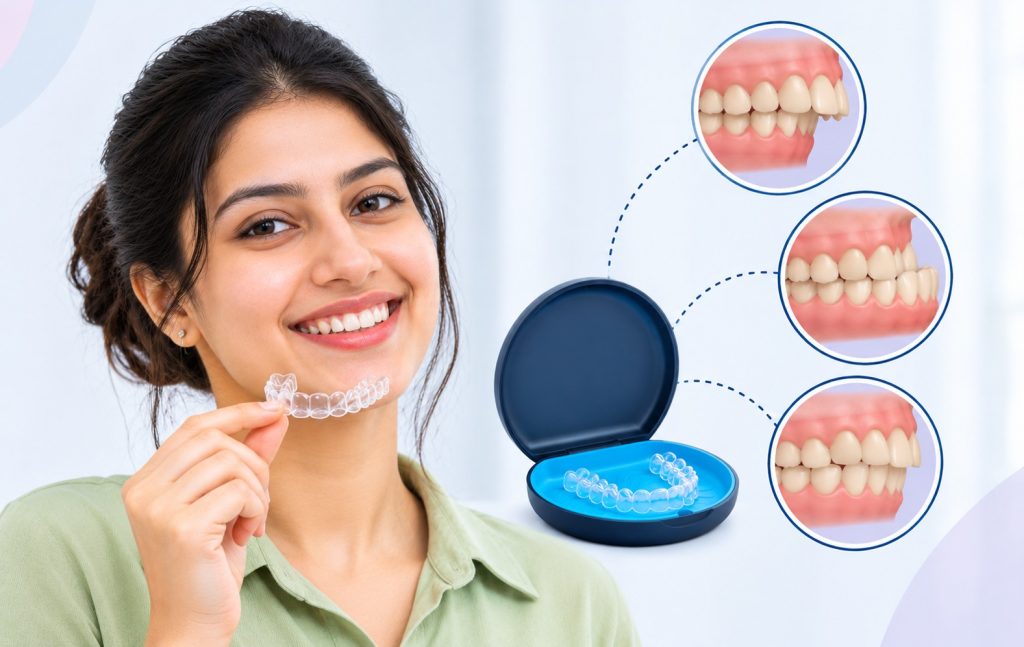
First of all, a well-aligned bite is a combination of cosmetic achievement and a long-lasting foundation of good oral health. Teeth misalignment is one of the common issues that most people face, and it varies from minor to severe. It not only impacts your smile, but can also be responsible for many dental diseases.
And now, to answer your question, yes, Invisalign can fix overbite, underbite, and crossbite. Let’s understand how it actually helps to correct bite challenges, starting with what overbite, underbite, and crossbite are.
What are bite challenges?
Overbite
It is the overlap of the upper front teeth over the lower front teeth in the vertical direction. A mild degree of issue is considered normal, but extreme conditions demand orthodontic treatment.
| Common causes | Symptoms |
| 1. Inherited jaw structure
2. Childhood habits like prolonged thumb sucking or use of a pacifier 3. Bruxism (teeth grinding) 4. Missing teeth, which is causing the upper teeth to drop further |
1. Visible forward protrusion of the upper teeth
2. Speech challenges like a lisp 3. Unable to open or close mouth properly 4. Tension in jaw while eating 5. Uneven wear of tooth enamel |
Crossbite
When upper teeth sit inside the lower teeth while biting rather than outside. Overlap of 2 to 4 millimeters is considered normal, but above that is considered a crossbite.
| Common causes | Symptoms |
| 1. Delayed or early eruption of baby teeth
2. Childhood habits like prolonged thumb sucking or use of a pacifier 3. Narrow upper jaw structure or a mismatch between the teeth and jaw 4. Habit of breathing through the mouth |
1. Strain in the jaw (in severe cases, it can lead to TMJ (temporomandibular joint))
2. Chewing or speech challenges 3. Top and bottom dental midlines unable to line up 4. Chipping, gum recession, and uneven enamel wear |
Underbite
When lower front teeth stick out past the upper teeth while opening or closing the mouth is one of teeth alignment challenges. In this situation, jaw structures are of normal size, but the position and angle of the teeth are not in a proper manner.
| Common causes | Symptoms |
| 1. Childhood habits like prolonged thumb sucking or use of a pacifier
2. Jaw trauma, growth issues, and improper healing 3. Inherited jaw structure or tooth alignment 4. Teeth growing in a crowding pattern 5. Overgrowth of the lower jaw |
1. Trouble biting or chewing
2. Chipping, gum recession, and uneven enamel wear 3. Mouth breathing, bad breath, or sleep apnea 4. Pain around the neck, jaw, and ear |
Is it a dental or a skeletal problem?
First the dentist first checks whether the problem is dental or skeletal so that it becomes easy to solve the issue.
- Dental problems- it is related to the position of the teeth which become challenging and cause problems. Mild teeth misalignment is common, and some don’t even require that much work, but when it comes to complex cases, sometimes additional procedures like tooth removal are performed. So, never ignore it if you start facing any dental problem, because even misaligned teeth can become a dental disease.
- Skeletal problems- this happens because of the position and size of the jaw, and in some cases, it can be hereditary. Smaller jaws, or jaws that are too forward, are some of the cases that can put pressure on jaw muscles, and in some cases, it can lead to TMJ.
Can Invisalign fix teeth alignment issues?
Yes, Invisalign is able to correct overbite, underbite, and crossbite. Aligners help to move teeth in a better position without a requirement of rubber. These are plastic trays that slowly move teeth. In some cases, where teeth are overcrowded, a tooth removal procedure is done first to make room for other teeth to move, and then Invisalign braces are recommended. Every 2 to 3 weeks, the Invisalign tray is changed to move teeth slowly without putting lots of pressure in one go. It is recommended to wear for at least 20 to 22 hours a day for better results.
It helps to move misaligned teeth inward and outward when the problem is related to mild arching. But if the issue revolves around skeletal problems, other treatments like a palatal expander are used. This usually happens in very few cases. In the beginning, it might cause discomfort, but over time it becomes comfortable to wear.
How do aligners correct a bite?
In some cases, clear aligners require some additional tools to make them work-
- A custom tray that moves teeth little by little.
- Elastic rubber bands are attached between lower and upper teeth to adjust the arches.
- Tooth enamel is smoothed to create some space.
- For aligner grip, tooth colored bumps are bonded.
Conclusion
Invisalign is used to correct different types of overbites, crossbites, and underbites only if the problem lies in the location of your teeth. If the reason for your issue is related to the jaw, then other ways, including braces and even surgery, will have to be used. That is why experts at Vera Dental Care first understand where the actual reason lies, and then proceed with the treatment.
The best way to understand if your bite can be corrected with invisible braces is to visit the dentist, who will explain to you all the details about your situation honestly. If you are not sure how to correct your bite with invisible braces? Make an appointment with Vera Dental Care, Jaipur.
FAQ’s
Can Invisalign correct bite problems?
Yes, it can help improve bite problems. This is recommended in mild to moderate cases.
Are Invisalign better than traditional braces?
Both of the treatments are effective and help to resolve teeth misalignment problems. However, braces are highly recommended in severe cases, as they provide better support and control.
How long will it take to solve bite correction with Invisalign?
It completely depends on the condition of the teeth, maintenance, and the time someone wears them each day. On average, it may vary between 6 months and 2 years.
What is the right age to straighten teeth?
It can be done at any age, because dental science has brought a number of possibilities, and Invisalign is one of the treatment option which does not compromise appearance and slowly help to solve the problem.
Can children use Invisalign for bite problems?
It depends on the age, growth, and type of dental problem. As their jaw structure is growing, the dentist first checks their growth pattern and then recommends the treatment that fits right as per their requirement.