
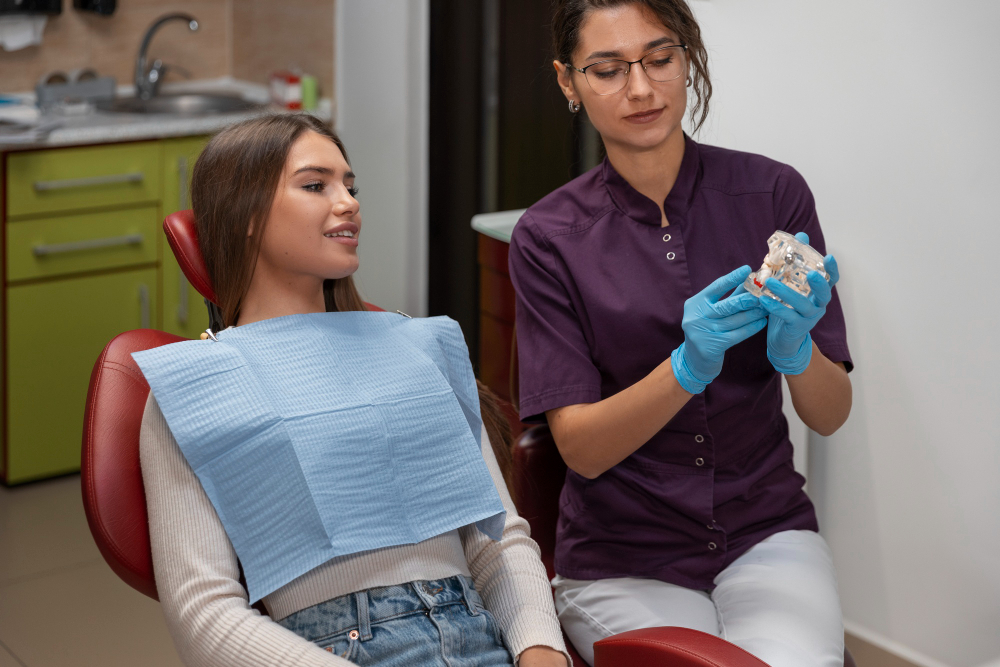
Ever caught yourself closing your lips tight or hiding a smile just to get a good photo, or dealing with stuck food between teeth because of the misalignment of the teeth. Your uneven teeth might look normal, but they are not hiding your smile, but can also cause challenges later in your life. It creates space for food to get stuck, and if proper oral hygiene with brushing and flossing is not maintained, it can lead to the buildup of bacteria, resulting in gum diseases.
So, rather than dealing with major issues, it is better to deal with them now with teeth alignment treatment.
At Vera Dental Care, we often meet patients who waited years before actually taking steps towards dental health. This article helps you know the 7 signs you may need teeth alignment treatment.
What is Teeth Alignment Treatment?
It is an orthodontic treatment in which mild, gentle and continuous pressure is applied to treat crowded, crooked or misaligned teeth. Using braces or aligners, the teeth started to shift to the position that to be, to improve the smile. It is the easiest way to treat misaligned teeth, and yes, it can be done for teenagers as well as adults.
The 7 signs that you need teeth alignment treatment
- Crowded or overlapping teeth- it happens when the jaw is too small, or the teeth are large and unable to fit in a straight line. As a result, teeth start to grow twisted, rotated, or pushed in front of or behind each other. It can increase the risk of plaque buildup and make it harder to clean teeth properly.
Common causes-
- Inherited size of the jaw and teeth independently
- Due to loss of baby teeth in the early stage of life
- Childhood habits like thumb-sucking or use of a prolonged pacifier
- Age-related issues
- Facial trauma or missing teeth
- Wisdom teeth might have pushed the teeth forward by putting pressure
- Gaps between the teeth- it is also known as diastema, and it commonly happens between the two front upper teeth. The gap between the teeth can happen anywhere in the mouth, and this mainly happens because of the mismatch between the size of the jawbone and the teeth.
Common causes-
- Gum diseases weaken the support around the teeth.
- Undersized teeth or missing teeth can make neighbouring teeth shift into the space.
- Childhood habits like tongue thrusting or thumb sucking can lead to this
- Overgrowth of the frenum (it is the tissue which connects teeth with the gums)
- Mismatch between the size of jawbone and teeth, leaving extra space for teeth to shift
- Underbite or crossbite- when lower teeth sit in front of the upper teeth while closing it is called underbite, and when upper teeth bite sites inside the lower teeth while resting is called crossbite. Underbite usually impacts the entire front lower arch, growing the lower jaw too large and the upper jaw too small. Crossbite can impact the entire side or the arch.
Common causes-
- Imbalance between the upper and lower jaw growth
- Physical injury or fracture
- Absence of teeth or presence of extra teeth
- Child born with cleft lip
- Childhood habits or breathing through the mouth (this can narrow the upper palate)
- Delayed loss of baby teeth
- Abnormal tooth eruption
- Narrow upper arch
- Overbite- it is the overlap of upper front teeth over lower front teeth. People with excessive overbite have an overlap of lower and upper teeth by 4 millimetres, which can lead to structural complications. It can lead to TMJ disorder, jaw pain, tooth damage, speech difficulties, or even breathing difficulties.
Common causes-
- Childhood oral habits
- Teeth grinding or clenching
- Crowded teeth
- Tongue thrusting
- Breathing from mouth
- Jaw discomfort or uneven tooth wear- it is closely linked to the jaw muscle strain, teeth grinding, clenching or unbalance bite. Due to excessive pressure, upper and lower teeth do not meet, and this is called jaw discomfort. This can lead to premature enamel wear, chipping, or flattening because of the force on jaw joints and muscles.
Common causes-
- Temporomandibular joint disorder (TMJ)
- Bite misalignment
- Excessive stress or tension on jaw muscles and joints while doing heavy exercise or in stress
- Teeth grinding
- Difficulty in biting, chewing or speaking clearly-the sounds that come out when pronouncing “s”, “z”, and “th” require the involvement of the tongue together with air passing around the upper front teeth. Anything that prevents air from passing around will result in a lisp or whistling sound.
If a person chews food from one side of the mouth more frequently, this is caused either by discomfort on the other side or misalignment of the teeth. Over time, it causes wear of teeth as well as jaw strain. Biting problems can cause issues with biting or cutting food using your front teeth.
Common causes
- Genetic developmental challenges
- Malocculsion
- Tongue tie or ankyloglossia, where a tight lingual frenulum restricts the tongue’s range of motion
- Improper jaw muscle habits
- Ill-fitting dental wear
- Childhood habits
- Open bite-it is a type of malocclusion where lower and upper teeth are unable to touch properly when the jaw is completely closed. It can lead to chronic headaches, jaw pain and even TMJ.
Common causes-
- Childhood habits like finger or thumb sucking, excessive use of a pacifier
- Inherited skeletal jaw structure, chronic mouth breathing or even macroglossia (usually a large tongue)
- Tongue thrusting
- Jaw injuries
- Abnormal tooth eruption, poorly fitted dental restoration
What happens if you ignore these signs?
- Crowded or overlapping teeth make it harder to clean, which can cause plaque to collect, leading to cavities and gum diseases.
- Chewing becomes less comfortable as the teeth do not fit properly
- Build-up plaque can irritate gums.
- Trapped food can lead to bad breath.
- Jaw muscles work harder due to uneven teeth alignment, which can cause discomfort.
- Gaps or misplaced teeth can affect speech, for example, a lisp.
Treatment Options
- Traditional metal braces- these are stainless steel brackets which are connected to the teeth using an archwire and secured with elastic ligatures, which help to move teeth gradually. It is crucial to visit every 4 to 8 weeks to tighten the wire to slightly move teeth.
- Ceramic braces- this is similar to traditional metal braces, but the only difference is, in this tooth coloured or clear brackets are used and connected with metal archwire. These are less visible than metal braces, but offer the same response.
- Clear aligners- it is a transparent and removable plastic tray which is used to straighten teeth without any wires or metal brackets. It is required to wear for at least 22 hours a day to get the desired results. In the beginning, it might be difficult and make you uncomfortable, but over time it will become comfortable.
- Lingual braces- these are custom-made orthodontic devices which help to fix the tongue-side surface of the teeth. As they are used to cover the sides of the teeth, they are completely hidden from the outside.
- Short-term orthodontics:this method is to treat 6 to 8 teeth only rather than fixing a complete bite of jaw alignment. The only limitation is that it does not fix underlying skeletal or major bite challenges, but it can help to improve the structure of the teeth. It uses targeted clear aligners, or cosmetic braces with accelerated techniques.
- Retainers- this is usually recommended once the treatment like braces or aligner are completed. These are removable transparent trays which help to keep the shifted teeth in an aligned manner and protect teeth from moving.
| Treatment | Visibility | Suitability | Duration | Comfort |
| Traditional metal braces | Clearly visible | For mild to complex cases | 1 to 3 years | Mild soreness as they typically move teeth slowly |
| Ceramic braces | Clearly visible | For mild to complex cases | 1 to 3 years | Similar to traditional braces |
| Clear aligners | Invisible | For mild to complex cases | 6 to 12 months | Can be removed, so it is more comfortable than braces |
| Lingual braces | Hidden, as these are used on the side of the teeth | Those who are looking for hidden braces | 1 to 3 years | Can irritate the tongue and might cause difficulty while speaking and can be hard to clean. |
| Short-term orthodontics | Usually discreet | For minor cases | 3 to 9 months | Comfortable |
| Retainers | Barely visible | Usually recommended after teeth alignment treatment is done | Offer long-term outcomes | Comfortable than others |
Is it too late for adults?
People often ask: Is it too late for me to get braces, or are they as effective for adults as for children?
It is never too late to get teeth alignment treatment. Although as age progresses, the time to improve the alignment of teeth might increase because of the gums and jaw structure, but you will get the desired results. In children, their gums and jaw bones are developing, so it becomes easy for their teeth to shift into an aligned position.
Yes, indeed, adults’ teeth take longer to get into an aligned position than children’s because their jawbones and supporting bone structure are fully developed, which makes it denser and harder. In children, they are in an active growth phase, which makes it easy to correct skeletal discrepancies.
Conclusion
Misalignement is a common challenge that most people experience, and treatment is possible for children, teenager, or even adults. If crooked teeth, gaps or even bite problems have been bothering you for years, then this is a clear sign that you need a teeth alignment treatment. Age does not define whether someone should get a healthy smile or not.
At Vera Dental Care, our professionals understand the concerns of every patient and create a plan based on their goals. Moreover, if you are looking for guidance related to dental health or oral hygiene, contact Vera Dental Care.
Book your consultation!
FAQS
How do I know that I need teeth alignment treatment?
If someone is dealing with protruding teeth, have gaps or spaces, even or crowded teeth, then teeth alignment treatment can help to achieve a healthy smile. Misaligned teeth can cause difficulty in cleaning them properly, which can lead to bacteria or plaque buildup.
Are clear aligners as effective as braces?
Aligners are as effective as braces, but they are used for mild to moderate cases, while braces are highly recommended for severe misaligned teeth.
Do I need a retainer after teeth alignment treatment?
Yes, retainers are necessary as these help to keep teeth shifting back to their previous position.
How long does tooth alignment treatment take to complete?
It completely depends on the case and type of treatment you are opting for. Most people are recommended to wear braces for at least 18 months, while some require only 6 to 12 months to completely improve the alignment of their teeth.
What to avoid after teeth alignment treatment?
The purpose after the treatment is to prevent teeth from shifting, and for that, retainers are necessary to wear. Moreover, it is good to avoid teeth grinding, sticky food and hard food, visit your dentist regularly, ensure dental hygiene, and don’t delay if you start noticing anything unusual.
Can all crooked teeth be corrected after teeth alignment treatment?
No, all crooked teeth cannot be corrected, because in severe cases, skeletal jaw misalignment and poor bone health require surgical intervention.
Is teeth alignment treatment painful?
It is uncomfortable and a little painful because the treatment slowly moves their teeth in an aligned manner which might cause little pain in the gums.
What is the cost of teeth alignment treatment in Jaipur?
It depends on the severity and type of treatment someone chooses. Also, even after choosing the same treatment as others, the overall cost may vary. But if you are looking for professional help, then Vera Dental Care is the one.