
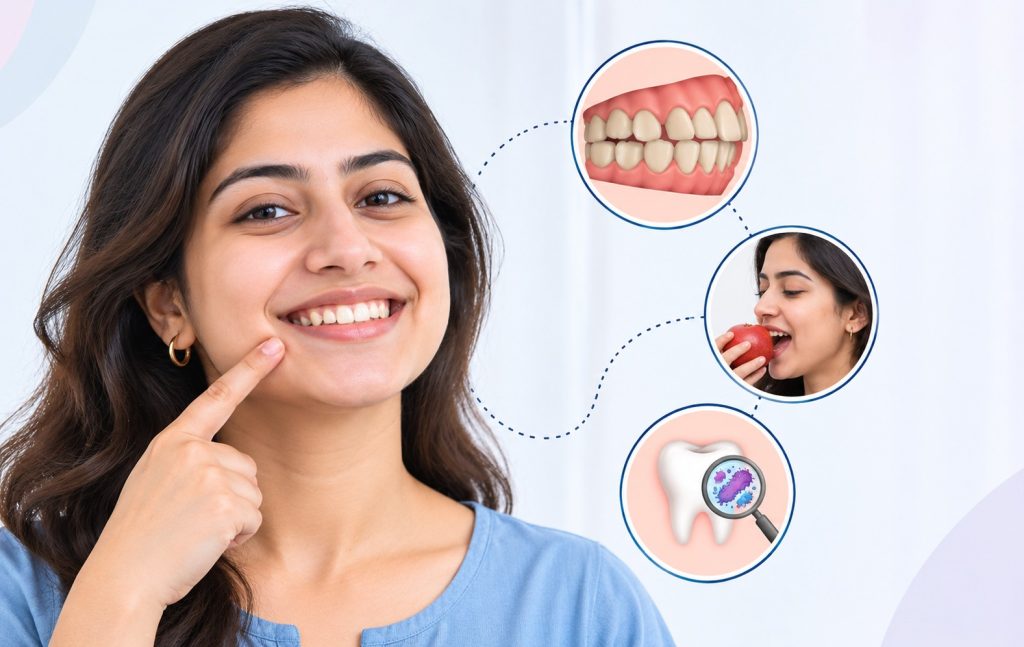
This question would most probably get answered with “yes,” but then again, the extent of the effect would certainly differ from one individual to another.
Your bite misalignment affects your smile and dental health more than you think, but the connections between jaws can lead to several forms, like underbite, overbite, and crossbite. Let’s see the effects one by one in this blog and know when you need to visit your dentist. At Vera Dental Care, Jaipur, we are here to help you out with this issue.
What is Malocclusion?
It is also called a bad bite, where the upper and lower teeth do not align properly when closing the mouth. Due to this, it can become difficult to chew, bite, or even close the mouth properly, and it can put a lot of strain on the jaw and wear down the enamel. This might surprise you to know that jaw pain along with popping can become a complicated issues which don’t even think of.
How common is the problem?
The majority of people are dealing with some kind of teeth misalignment. Slightly overlapped, minor gaps are some small degree problem which do not require any treatment. These do not cause any problems, but some still choose to correct them through braces or Invisalign.
But there are people who are dealing with moderate to severe tooth misalignment, and this does not only impact how they smile, but also impacts how they eat and maintain oral hygiene. It becomes difficult to maintain good oral health and requires treatment.
Why is early dentist intervention necessary?
If you are noticing a bite problem or pain in your jaw, then it is important to visit the dentist and get the correct treatment. Let’s look at how bite can affect muscles and joints-
- Clocked jaw- due to uneven pressure distribution, jaws start to click and pop while eating or biting. In the beginning, it might look normal, but over time it can lead to problems like TMJ.
- Uneven tooth wear- flattened, shortened, or even chipped edges can happen but putting pressure on specific points while chewing, and through repeated force on high contact areas it can wear down enamel and expose underlying dentin.
- Headaches- tension on temples due to grinding and clenching can cause morning headaches. So, if you are experiencing frequent headaches, then it is better to visit your dentist to know the actual problem.
- Jaw fatigue- due to a tired, or achy jaw after eating or talking can stem down because of overuse of muscles, grinding and clenching.
Impact of teeth misalignment on
Bite
- Upper and lower teeth are unable to meet while biting because of misalignment of the teeth that have unequal forces.
- Misalignment causes various bites such as overbite, underbite, crossbite, and open bite.
- The additional force causes tooth damage and wear of teeth.
- Eating from one side of the mouth (where you feel comfortable) starts to put pressure on one side, which ultimately results in jaw problems.
Chewing
- Difficulty in biting and tearing of food because of the problem of improper bite.
- People tend to chew the food from one side. This puts unnecessary pressure on one side of the mouth, leading to wear of teeth on one side and fatigue of the jaw.
- Lack of ability to chew food correctly leads to difficulty in eating your meals and getting full nutrition (which is one of the core reasons to eat food).
Oral health
- Overcrowded or overlapped teeth become harder to clean properly.
- If teeth are misaligned, then it becomes easier for food to get stuck in between, and this is one of the most favourable conditions for bacteria to grow.
- It increases the risk of cavities and gum irritation, which ultimately result in inflammation.
Plaque can easily where where brush and floss are unable to reach.
Common causes and symptoms
Causes:
- Inherited from genetics
- Wearing ill-fitted bridges, crowns, or dental restorations
- Dental trauma
- Teeth grinding or clenching
- Tumor that has impacted the tooth and jaw
- TMJ (temporomandibular joint) disorder
- Tooth loss
Symptoms
- Biting cheek frequently
- Popping sound while biting or chewing
- Waking up with a locked jaw
- Speech issues like lisping
- Mouth breath
- Bad breath
- Teeth are aligned properly
Complications that you might face
- Continuous pain in the jaw
- Sleep disorder or sleep apnea
- Tooth erosion
- Malnutrition as your biting is restricted, making it hard to chew properly
- Gum recession
- Gum issues
Treatment options
- Braces- these are one of the most recommended treatments. Using wires and rubber, and attaching with teeth to provide support and control. And over time, these wires are tightened by the dentist to move teeth slowly into their new position.
- Invisalign- these are clear trays that are invisible and removable. People started to choose this treatment because these can be removed while eating and drinking, making it easier to maintain oral hygiene and prevent bacteria and bad breath.
- Jaw surgery- this is recommended to fix a jaw fracture or even in TMJ disorder. That is why dentists always recommend treatment for a popping jaw, because this is just the beginning of TMJ.
- Tooth extraction- when teeth are overcrowded and do not have space to move, then this step is performed.
- Orthodontic headgear- this is a device that fixes bad bites by positioning teeth and jaw in an aligned manner.
Conclusion
There may be some other problems related to misaligned teeth, other than the aesthetics of your teeth. This could affect your teeth, gums, and jaw muscles, leading to pain in your jaw while biting. Also, it further leads to cavities or some other problems because of poor oral hygiene. But not everyone suffers from this problem, and it can be treated through diagnosis.
If this sounds similar to you, it is time to visit the dentist and start your treatment. Moreover, if you have any questions related to dental health or oral hygiene, contact Vera Dental Care.
Book your consultation now!
FAQ’s
Does misalignment of teeth affect my bite?
Yes, misalignment of teeth leads to poor fitting between the upper and lower set of teeth. This can result in overbite, underbite, crossbite, and open bite, which leads to excessive pressure on specific teeth.
Does misalignment of teeth lead to cavities and gum disease?
Misalignment of teeth increases the risk of getting cavities and gum disease because food gets stuck between the teeth, making it difficult to clean. There is also a buildup of plaque in areas where one cannot reach with the brush. Proper brushing and flossing help prevent cavities and gum disease.
Do crooked teeth affect chewing?
Yes, there are cases where some people have problems biting into food, while others find it hard to chew evenly. It leads to wear on the teeth and causes fatigue in the jaw muscles. Problems with chewing as a result of misalignment of teeth can be diagnosed by dental examination.
Does misalignment of teeth cause jaw pain?
Yes, it can, since it results in an uneven bite and thereby puts pressure on jaw muscles.
Which treatment is better to treat teeth misalignment or bite problems?
It completely depends on the type of challenge, and after conducting a thorough analysis, the dentist recommends the treatment.